
By Christopher Neilson
Professor of Economics, Yale University
Founder, TetherEducation and & ConsiliumBots
This is the first in a series exploring how AI can transform access to education services
Most discussions about AI in education focus on its potential impact on learning, classrooms, and teachers. A quick scroll through LinkedIn or Twitter offers numerous perspectives on these questions. Yet, one of the most powerful and immediately actionable ways AI Agents will impact education is by changing how families access education services and subsidies already available to them.
Across educational services—from childcare to higher education and job training—government programs aim to expand opportunities by subsidizing access or providing services directly. However, despite these good intentions, programs frequently fail to reach the individuals who need them most. Research consistently demonstrates that complexity and bureaucratic hurdles create substantial barriers and reducing them is one of the most cost effective ways to improve efficiency and equity in education markets.
Education as a High-Friction Market
Educational services are delivered in what can be characterized as "high-friction" markets, where transactions between service providers and families involve significant informational, procedural, and psychological costs. These include:
Complex eligibility criteria
Opaque application processes
Poorly communicated or inaccessible information
High cognitive and time demands for completing procedures
Lack of transparency regarding costs and benefits
These frictions disproportionately impact vulnerable families, limiting the equity and effectiveness of education policies.
FAFSA: A Canonical Example
In the United States, applying for federal student aid involves completing the FAFSA, a detailed form requiring household income and tax information. Although not extremely difficult, it presents enough complexity to deter some families from completing it.
A landmark H&R Block RCT study “The Role of Application Assistance and Information in College Decisions: Results from the H&R Block Fafsa Experiment” by Eric Bettinger, Bridget Long, Philip Oreopoulos, and Lisa Sanbonmatsu demonstrated the powerful impact of removing these procedural frictions. In their randomized trial, H&R Block professionals assisted low-income families in completing the FAFSA using their tax returns.
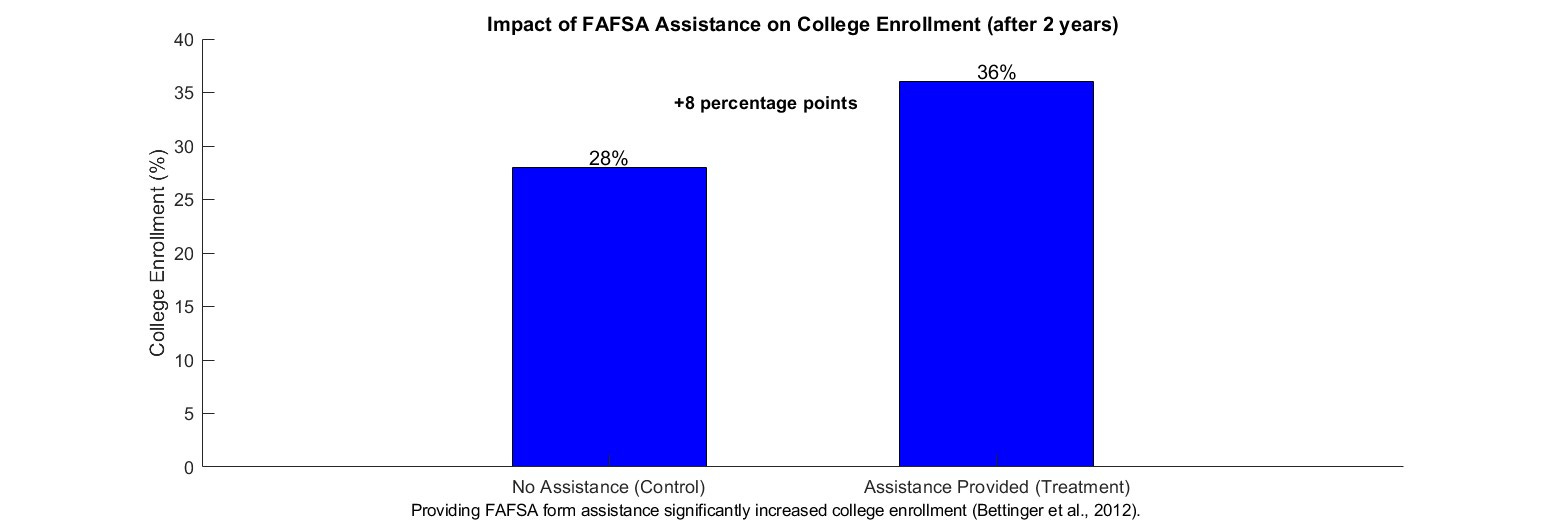
🎯 The result? Students who received help were significantly more likely to enroll in college and secure financial aid. Simply removing a friction, a procedural barrier of minor cost or relevance - led individuals to make one of their biggest finanial decisions in their live. Many studies followed finding similar results where reducing seemingly small frictions led to important improvements in access to education. Unfortunatly, changes to policy design have been slow. Its been more than a decade since the FASFA H&R Block study was published and there has been only limited success in simplifying the process (although some progress was made).
Beyond FAFSA: AI Agents as Navigation Infrastructure
Replicating a H&R Block representative is at the top of my list for AI Agents. It is the perfect example of a scalable application for an Agent to help an individual blow through a tedious and potentially confusing but straightforward process.
However this concept translates to many other contexts where families are trying to get access to education services and subsidies1:
📌 Schooling vouchers or Education Savings Accounts (ESA)
📌 Common application and assignment systems
📌 Head Start/Childcare assistance application and waitlists
AI Agents can serve as critical navigation tools—providing tailored, real-time assistance by:
Clearly explaining eligibility rules
Pre-filling and completing forms
Tracking deadlines and sending reminders
Navigating complex workflows
Personalizing information based on user context
Communicating effectively family preferences to strategic assignment algorithms
These agents function as scalable digital caseworkers, leveraging sophisticated AI models to dynamically support users building on decades of research in behavior economics and market design.
Stumbling Block: Integrating with Legacy Public Systems
AI Agents designed to facilitate access to government-subsidized services face significant integration challenges when interacting with legacy public-sector platforms. These older government systems typically lack modern APIs and are often not designed to allow secure authorization tailored specifically for AI-driven intermediaries acting on behalf of families. Persuading policymakers and platform administrators to update authentication processes to accommodate automated Agents remains a substantial stumbling block. A complementary approach employs AI Agents in collaboration with families, guiding them through these legacy platforms step-by-step. These browser Agents do not fully automate interactions due to authorization constraints, but they effectively support families by simplifying navigation and making sure families do not get “stuck” at critical nodes of the process.
Implementation and Evaluation : App/Enroll Agents:
At TetherEd we’re excited to be working with researchers Sebastian Otero of Columbia University and Claudia Allende of Stanford GSB to pilot an innovative AI Agent initiative with the school district SLEP del Pino in Santiago, Chile. With the support of OpenAI Economics Unit, we are implementing AI agents that represent individual schools, assisting families with digital applications, form completion, waitlist updates, and real-time slot availability. Agents fully manage the entire application and enrollment process digitally and help families along the way to make sure everyone can get access.
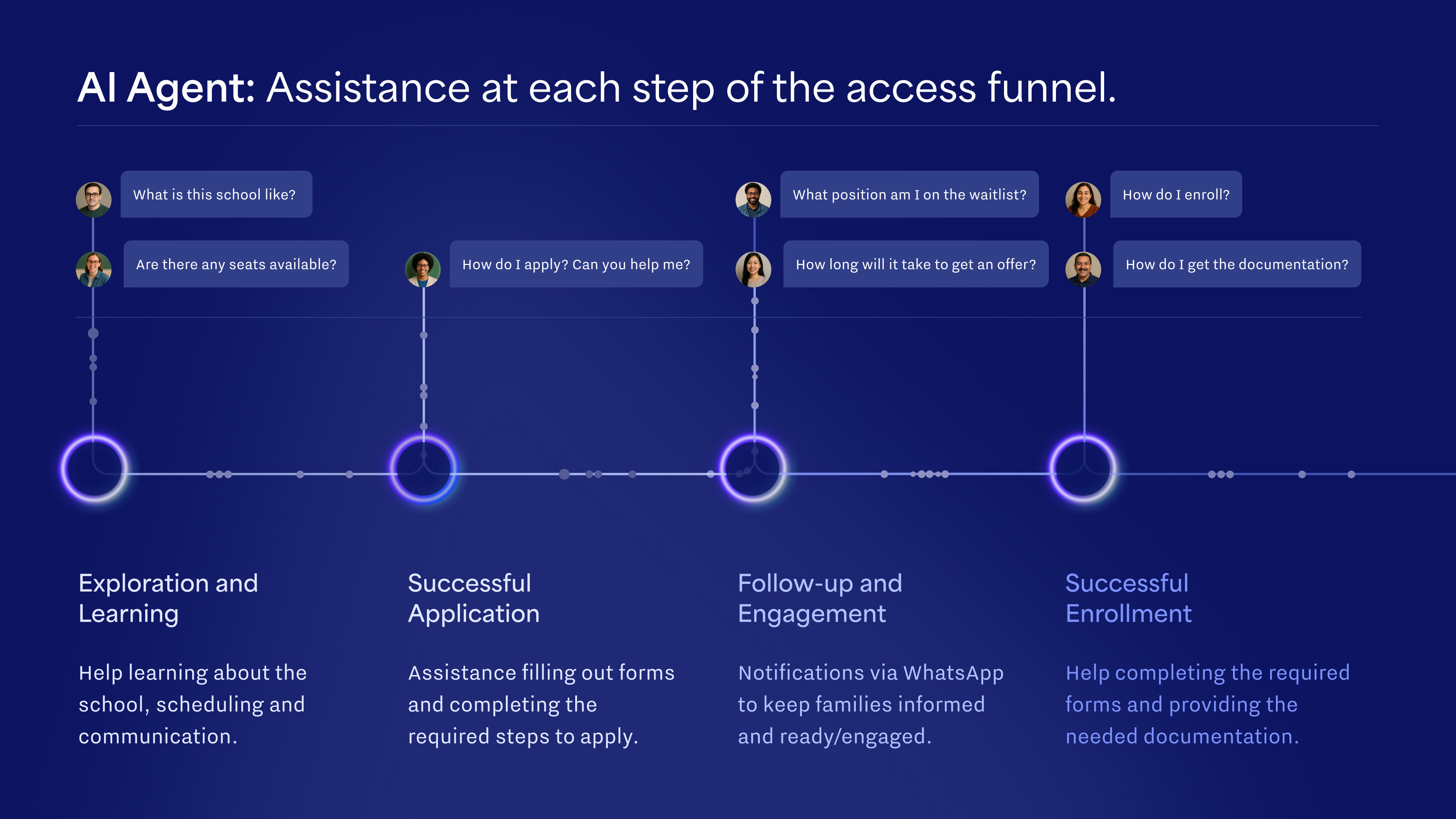
Working together with the director Pablo Araya of SLEP del Pino and the researchers, , a randomized controlled trial (RCT) will be implemented to compare schools equipped with AI Agents to those without. Importantly, these schools already have digital application and enrollment, so this study isolates the value added by the Agent in addition to digitalization of procedures.
The evaluation focuses on equity in access, operational efficiency, waitlist processing speeds, and overall enrollment rates. Early expectations are that these AI Agents will significantly reduce digital divides, enhancing the ability of less digitally savvy families to successfully apply and enroll. We also expect overall capacity use will increase.
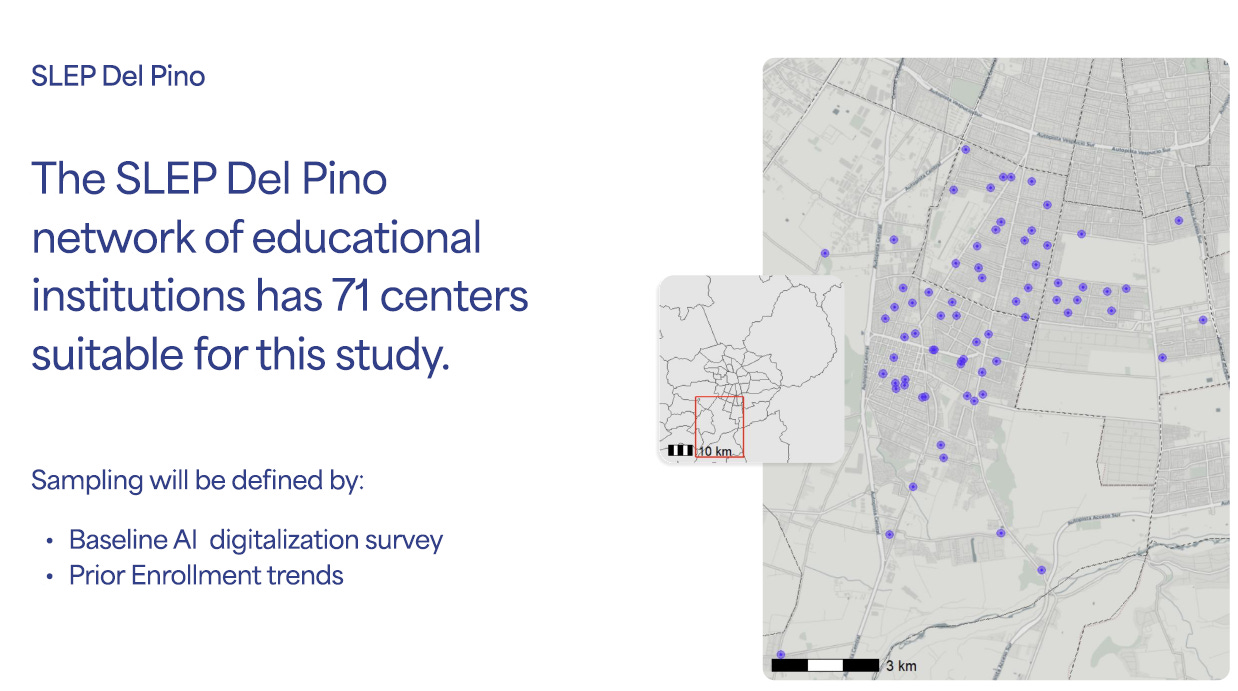
This pioneering pilot, pending further funding, aims to expand to a city in Colombia either Medellín or Cali in 2025 to evaluate external validity of the results. In 2026, the plan is to evaluate the equilibrium effects of AI Agents at scale and to do so, the RCT will expand to 1000 schools in Santiago.
This post is the first in a three-part series exploring AI Agents effect on access to education:
Getting Access: Navigating Access Workflows
Simplifying multistep procedures by filling out forms, tracking deadlines, sending reminders, and helping families access existing education services and subsidies.
Getting Access to the Right Education: AI Agents and Information Inequality Providing personalized information about education options, correcting biases, and improving access to critical information to help choose investments in human capital.
Tide that Lifts All Boats: Equilibrium Effects of Reducing Frictions at Scale How AI-driven platforms will make demand more elastic to education quality, fostering competition and overall improvements in service delivery for everyone.
Are you working on improving access to public services through technology? I'd love to hear from you. Share your experiences in the comments or reach out directly.
This applies more broadly to health and housing services as well. I’ll discuss the general “AI Agent and high friction markets for social services” in another post.